
Solving a combinatorics problem with a team of four LLMs
Take a 16×16 grid of unit squares. Place axis-aligned rectangles on it so that every row and every column has exactly one square left uncovered. What's the fewest rectangles you need?
A single agent tends to get this wrong in a confident way: it finds a construction, convinces itself of a matching lower bound, and writes up a clean, self-consistent, incorrect answer. We ran it through the future-loop multi-agent control plane instead — four different models working in parallel, with an orchestrator that coordinates but is forbidden from solving. The answer is 21. The interesting part is how the system got there.
The orchestrator doesn't solve anything
The whole run is driven by future-loop, FutureOS's control plane for multi-agent work. The user's prompt to the orchestrator ends with a hard constraint: do not do any solving in this session. The orchestrator's job is limited to decomposing the task, scheduling workers, adjudicating results, and keeping the evidence ledger. All the mathematics happens in the worker sessions.
A few mechanisms carry the weight:
- Goals and work cards. The task is broken into cards, each with a priority, dependencies, and a single owner. One worker per card, so parallel workers can't claim each other's work.
- Verify gates and evidence. Every deliverable card binds a shell command (e.g.
test -s <report path>) and a non-empty evidence note. When a worker claims done, the control plane runs the gate itself; if it fails, the claim isn't accepted. - A shared board. Workers can only append short conclusions (3–5 lines) to a shared file — the only cross-worker broadcast channel. Each worker also gets its own artifact directory, so nobody overwrites anyone else.
- Steering. The orchestrator can inject an instruction into a worker at any time. We used this once to rescue a worker that had been running for 40 minutes without writing anything to disk.
- Fault recovery. Infrastructure failures (an upstream disconnect, say) are marked recoverable: the session is kept, context replayed, the run resumed — without spending the run's error budget.
Before any worker started, the orchestrator wrote the shared notation and collaboration protocol into PROBLEM.md — how to denote a hole, the tile coordinate format, what a verification script must do — so any worker's result could be re-run by any other. That "protocol first, then work" discipline turned out to matter.
The problem
Because each row and column has exactly one uncovered square (a hole), the holes are U = {(r, π(r))} for some permutation π of {1..16}. A tile is a rectangle containing no hole. For a fixed π, let τ(π) be the fewest tiles that exactly partition the board minus the holes. The answer is k* = min over π of τ(π).
Four models worked as workers: glm-5.3-flash (audit / counterexamples), deepseek-v4-pro (proofs / constructions), kimi-k3 (construction search), and gpt-5.6-sol (independent exploration, reflection, final review). They also had real solvers: Z3, OR-Tools CP-SAT, Kissat, HiGHS, and a hand-written bitmask DFS for small cases.
The timeline
The run went 22:05 → 02:34, 269 minutes of wall clock, 15 rounds.
| Stage | Time | What happened |
|---|---|---|
| Parallel explore | 22:05–22:49 | All four workers start. gpt(low) answers k = 30 in 2.1 min with a diagonal construction; deepseek gets k = 23; kimi uses exact small values (n = 4..7 give 5, 7, 8, 10, all below 2n − 2) to disprove the universal lower bound and gets k = 22; glm times out with nothing on disk, is steered back, and reproduces k = 30. |
| Cross-reflection | 23:00–23:04 | gpt(high) re-runs all four verifiers and adjudicates: the k = 30 lemma and the k = 23 formula are both killed by the k = 22 counterexample. The state tightens to 15 ≤ k* ≤ 22. |
| Second round | 23:06–23:57 | deepseek finds a 4×4-grid permutation construction with k = 21 and proposes a lemma; gpt's joint SMT (permutation not fixed) independently finds the same construction mirrored, and proves n=16, k=20 UNSAT (221 s); kimi proves by exact ILP that this permutation needs exactly 21; glm cross-reproduces all the small exact values. |
| Adversarial final check | 00:09–02:19 | kimi: 57,897 exact ILP instances (including a complete 2-swap neighbourhood) hit nothing at k ≤ 20; deepseek formalises the lemma's decomposition and induction; gpt: CP-SAT returns INFEASIBLE twice and CNF/Kissat reproduces the construction a third time; glm audits all 48,232 permutations up to n = 8 with zero violations. |
| Final review | 02:28–02:34 | gpt(high) re-runs the key verifiers and actually re-runs CP-SAT (INFEASIBLE again, 94 s), writes the final report, and the goal closes its verification loop. |
The answer is 21
The construction uses the permutation π(r) ≡ 4r (mod 17):
π = 4, 8, 12, 16, 3, 7, 11, 15, 2, 6, 10, 14, 1, 5, 9, 13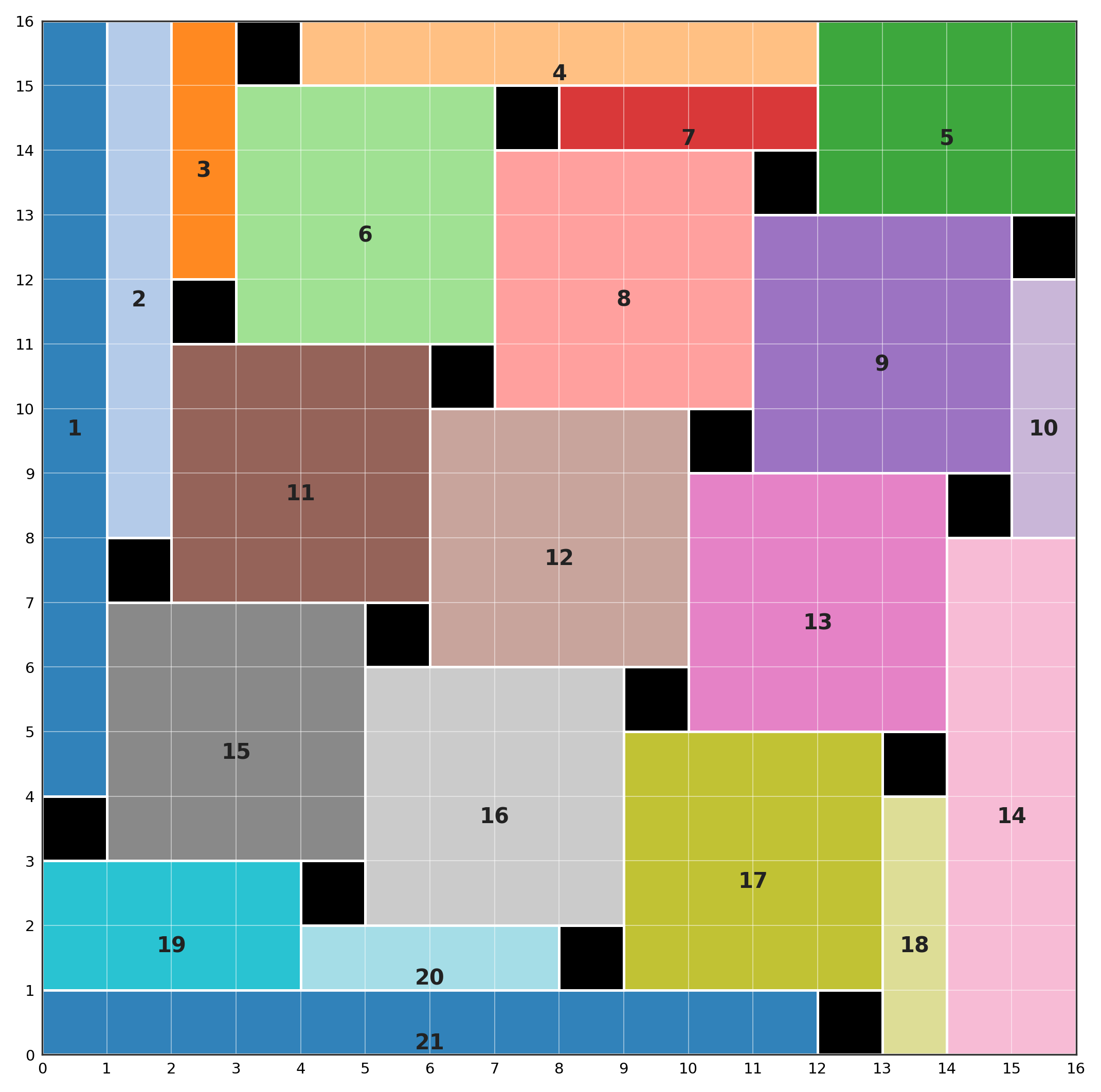
Figure 1: the optimal tiling. Black cells are the 16 holes (one per row and column); the colored numbered regions are the 21 tiles.
That gives k* ≤ 21. For the lower bound, a structural lemma ties the tile count to the permutation's longest increasing and decreasing subsequences (LIS / LDS): τ(π) ≥ n + LIS(π) + LDS(π) − 3. By the Erdős–Szekeres theorem LIS·LDS ≥ n, so for n = 16 you get LIS + LDS ≥ 8, and the lemma gives τ(π) ≥ 16 + 8 − 3 = 21 for every π. The decomposition and induction steps of that lemma are fully formalised; the base case (a closed-form witness set for simple permutations) is still open, though it's confirmed computationally for all 48,232 permutations up to n = 8 and for the specific balanced permutations at n = 16.
The neat part is that the lemma's bookkeeping explains every earlier wrong answer. The diagonal permutation has LIS=16, LDS=1, lower bound 16+16+1−3 = 30 — exactly its construction. The shuffle permutation has LIS=8, LDS=2, bound 16+8+2−3 = 23 — again exact. The only way to do better is to balance the two, and the 4×4 grid makes LIS = LDS = 4, hitting both the Erdős–Szekeres bound and the lemma's bound at once. Upper and lower bound meet on the same permutation.
Independently of the math, two exact encodings — Z3 (QF_LIA, cell-coverage semantics) and OR-Tools CP-SAT (NoOverlap2D + area conservation), with different front-ends and different solver kernels — both ruled out k = 20 with the permutation not fixed. Since any tiling with fewer than 20 tiles can be subdivided into exactly 20, ruling out 20 rules out everything up to 20.
What it cost
| Stage | Model (effort) | Time (min) | Input tok | Output tok | Cost |
|---|---|---|---|---|---|
| Explore | gpt-5.6-sol (low) | 2.1 | 170,499 | 4,865 | $0.78 † |
| Explore | deepseek-v4-pro (high) | 34.0 | 2,453,301 | 108,580 | ¥1.91 |
| Explore | kimi-k3 (high) | 44.4 | 622,961 | 74,681 | ¥19.93 |
| Explore | glm-5.3-flash (high) * | 48.5 | 135,763 | 43,868 | ¥0.09 |
| Reflect | gpt-5.6-sol (high) | 3.9 | 431,109 | 9,080 | $1.91 † |
| Round 2 | glm-5.3-flash (high) | 27.3 | 438,737 | 60,207 | ¥0.15 |
| Round 2 | deepseek-v4-pro (high) | 43.9 | 3,289,309 | 130,402 | ¥2.38 |
| Round 2 | kimi-k3 (high) | 48.9 | 865,052 | 16,195 | ¥18.92 |
| Round 2 | gpt-5.6-sol (high) | 51.5 | 1,181,143 | 15,773 | $5.04 † |
| Round 3 | kimi-k3 (high) | 27.9 | 985,814 | 14,915 | ¥21.21 |
| Round 3 | deepseek-v4-pro (high) | 35.0 | 3,131,360 | 124,650 | ¥2.36 |
| Round 3 | glm-5.3-flash (high) | 38.8 | 542,528 | 52,202 | ¥0.15 |
| Round 3 | gpt-5.6-sol (high) | 129.6 | 1,955,548 | 30,218 | $8.43 † |
| Final | gpt-5.6-sol (high) | 5.5 | 805,660 | 10,619 | $3.44 † |
| Total | 4 models / 15 rounds | 571 serial / 269 parallel | 17,008,784 | 696,255 | ¥67.08 + $19.5–38.5 † |
† gpt-5.6-sol is estimated at its promotional rate; the others are actual billed cost. * glm's first round timed out with zero output and was steered back.
Three things stand out. The fastest answer was the worst — gpt(low) gave 30 in 2.1 minutes, and the slowest chains were the valuable ones. Most of the wall clock was solver subprocesses and large enumerations (~2.9 hours), with LLM inference a small share — which is the shape you want: spend model time on thinking, wall time on computing. And kimi-k3 carried the heaviest ILP orchestration (81% of the domestic-model cost), but the two decisive breaks — disproving 30, and the final zero-hit verification — were both its.
Did anyone cheat?
Three layers of audit, all with re-checkable trails:
- Tool layer: across 15 runs the workers only used read / shell / write / edit. Web search, fetch, and browser calls: zero.
- Parameter layer: every worker transcript scanned for curl/
wget/ requests/ urllib/ httpx/ socket, search-engine and Q&A keywords, and external URLs. The only network activity was in one round-3 session — brew install kissat, agit cloneof drat-trim,pip install ortools— installing local solvers, not looking up answers. - Artifact layer: every part of the final construction and lower bound traces to a worker-generated script and output (verifiers, SMT2/CNF files with SHA-256, 57,897 ILP logs).
On "the model might just remember the answer": it can't be ruled out absolutely, but the four models gave 30, 23, 22, 30 in round one — memorised answers would converge. Two 21-tile constructions were found independently by two models that couldn't see each other's directories, as mirror images with full valid tilings. And the final answer is anchored by exhaustive local computation (UNSAT and ILP), not by any model's say-so.
Why multi-agent helped here
The answer went 30 → 22 → 21, and each drop came from a different model disagreeing with the others, not from any model reasoning harder. A single agent that settles on "diagonal + 30" with a self-consistent wrong lower bound would have shipped a wrong answer. What broke it was kimi-k3's small-case counterexample, then deepseek's permutation balancing for the second break.
The two 21-tile constructions found independently — one by ILP, one by SMT, under different encodings and solvers, as mirror images, then reproduced a third time by CNF/Kissat — are the strongest kind of cross-validation. And the adversarial split meant "find 21" and "prove 21" were attacked along four routes at once (construction search, mathematical lower bound, computational exclusion, method audit), each checking the others.
On the engineering side, verify gates turned "claimed done" into "verified done": 13/15 passed, 1 was blocked by a gate (the work got filled in the next round), 1 errored into failure and recovered. The final reviewer re-ran things instead of trusting summaries. And parallelism cut wall clock from 571 to 269 minutes — about 2.1×.
The honest caveats
An exploratory worker needs a "checkpoint to disk periodically" convention — glm's first round spun for 39.5 minutes with nothing written. The orchestrator made two bookkeeping errors (a mis-set card type, a mis-pointed dependency), both caught and corrected by the mechanism. kimi failed a verify gate in round two and its result was briefly invisible. There's no cheap second tier to offload heavy search to. And the n=16 machine-checkable DRAT/LRAT certificate didn't close — the biggest remaining formalisation gap.
Where this leaves it
A gated multi-agent orchestration can solve a mid-size combinatorial optimisation problem end to end: four heterogeneous models took the answer from 30 to a computationally-
The full case study (with the complete tile coordinates, the reproduction scripts, and the references) is the source for this post; the orchestration machinery is future-loop, the FutureOS loop control plane.